About Me

My photo
I'm Kimberly Rose D. Dipasupil. From San Mariano, San Pascual, Batangas. Taking Bachelor of Science in Information Technology at Lyceum of the Philippines University - Batangas

Thursday, August 11, 2011

- ENCRYPTION -


image credit : google.com

ENCRYPTION
     - is the process of transforming information using an algorithm to make it unreadable to anyone except those possessing special knowledge, usually referred to as a key. The result of the process is encrypted information. In many contexts, the word encryption also implicitly refers to the reverse  process, decryption to make the encrypted information readable again.

- ACCESS CONTROL SOFTWARE -


image credit : google.com

ACCESS CONTROL SOFTWARE
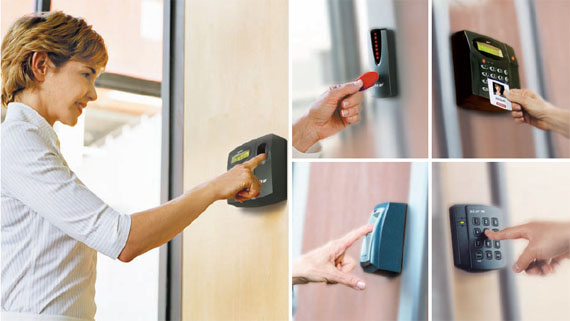
     - a system that enables an authority to control access to areas and resources in a given physically facility or computer-based information systems. An access control system, within the field of physical security, is generally seen as the second layer in the security of a physical structure.
**********************************************************************************
Physical Access
     - physical access by person may be allowed depending on payment, authorization, etc. Also may be one-way traffic of people. These can be enforced by personnel such as a border guard, a doorman, a ticket checker, etc., or with a device such as turnstile.

Access Control System Operation
     - when a credential is presented to a reader, the reader sends the credential's information, usually a number, to a control panel, a highly reliable processor.

Credential
     - a physical/tangible object, a piece of knowledge, or a facet of a person's physical being, that enables an individual access to a given physical facility or computer-based information system.  

Access Control System Components
     - an access control point, which can be a door, turnstile, parking gate, elevator, or other physical barrier where granting access can be electronically controlled.

Types of Readers
1. Basic (non-intelligent) Readers
2. Semi-intelligent Readers
3. Intelligent Readers

Access Control System Topologies
1. Serial Controllers
2. Serial Main and Sub-controllers
3. Serial Main Controllers and Intelligent Readers
4. Serial Controllers with Terminal Servers
5. Network-enabled Main Controllers
6. IP Controllers
7. IP Readers

- FIREWALL -

image credit : google.com

FIREWALL
     - a device or set of devices designed to permit of deny network transmissions based upon a set of rules and is frequently used to protect networks from authorized access while permitting legitimate communication to pass.
     - many personal computer operating systems include software-based firewalls to protect against threats from the public internet. Many routers that pass data between networks contain firewall components and conversely, many firewalls can perform basic routing functions.

Types of Firewalls

Network Layer and Packet Filters
     - operate at a relatively low level of the TCP/IP protocol stack, not allowing packets to pass through the firewall unless they match the established rule set. 

Application Layer
     - work on the application level of the TCP/IP stack , and may intercept all packets travelling to or from an application. In principle, application firewalls can prevent all unwanted outside traffic from reaching protected machines.

Proxies
     - may act as a firewall by responding to input packets in the manner of an application, while blocking other packets.

Network Address Translation
     - functionally, and the host protected behind a firewall commonly have address in the "private address range" as defined in RFC 1918.

- BIOMETRICS -

image credit : google.com

BIOMETRIC
          - or biometric authentication, consists of methods for uniquely recognizing human based upon one or more intrinsic physical or behavioral traits. in compute science, biometrics is used as a form of identity access management and access control. It is also used to identity individuals in groups that are under surveillance.

2 Classes of Biometric Characteristics
1. Physiological, related to the shape of the body
2. Behavioral, related to the behavior of the person

ISSUES AND CONCERNS

Privacy and Discrimination
     - it is possible that data obtained during biometric enrollment may be used in ways for which the enrolled individual has not consented.

Danger to Owners of Secured Items
     - when thieves cannot get access to secure properties, there is a chance that the thieves will stalk and assault the property owner to gain access. If the item is secured with a biometric device, the damage to the owner could be irreversible, and potentially cost more than the secured property.

Cancel able Biometrics
     - one advantage of passwords over biometrics is that they can be re-issued. If a token or password is lost or stolen, it can be cancelled and replaced by a newer version.

 Soft Biometrics
     - because of their inner nature are privacy preserving. They allow to describe a subject from his/her physical attributes.

International Trading of Biometric Data
     - many countries, including the US, already trade biometric data. 

Governments are unlikely to disclose full capabilities of Biometric Deployments
     - certain members of the civilian community are worried about hoe biometric data is used. Unfortunately, full disclosure may not be forthcoming to the civilian community.


Saturday, August 6, 2011

about to my post

all of my post in my blog are just required for my subject ETHICS
all of this are just an assignment that is given by our teacher/professor that we need to do because it is required to accomplish and to pass this subject


THANK YOU

Saturday, July 2, 2011

Ethics Lesson

 ImageCredit: myportfolio.usc.edu
 ImageCredit: toonpool.com
ImageCredit: hanggah.wordpress.com

Ethics Lesson

VideoCredit: mediarchives/YouTube